Downtown Toronto has approximately 75 designated on-street bus parking spaces, rush-hour restrictions, and a one-minute idling rule. A motorcoach cannot pull up, park, and wait. Groups that skip advance coordination with their operator — confirming loading zones, staging routes, and pickup sequencing — create problems on event day that a 56-passenger vehicle in Toronto traffic cannot recover from. This guide is for corporate coordinators, event planners, and anyone managing group travel into or out of downtown Toronto.
Key Takeaways
- The City of Toronto provides approximately 75 exclusive on-street bus parking spaces; it operates no off-street facilities
- Buses are prohibited from idling for more than one minute in any 60-minute period
- Unauthorized parking in a restricted zone carries a $300 fine
- On-street bus zones carry time limits ranging from one to 24 hours, with additional rush-hour restrictions
- Three named motor coach loading areas serve the downtown core: York Street at Sheridan Centre, Victoria Street at CAA Ed Mirvish Theatre, and Carlton Street at Holiday Inn Hotel
- Construction activity in downtown Toronto regularly affects curb-lane availability — confirm the route and loading zone within a week of your event
What Bus Parking Rules Apply in Downtown Toronto?
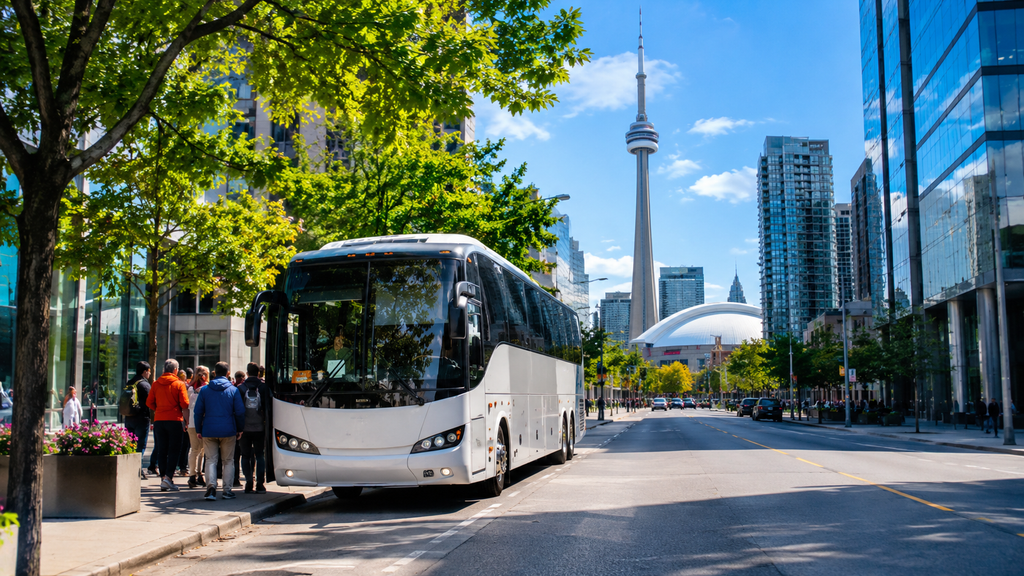
The City of Toronto provides approximately 75 exclusive on-street bus parking spaces across the downtown core. These spaces are designated, time-limited, and subject to rush-hour restrictions. The city does not operate off-street parking facilities for buses. Private commercial parking operators may offer off-street options, but availability varies and must be arranged directly before the event date.
On-street bus zones carry posted time limits ranging from one to 24 hours. Most curbside loading spaces have additional restrictions during rush hours. During those windows, a bus staged in the wrong lane is an enforcement target. Active passenger loading is permitted in designated loading areas. Holding or staging outside a designated zone is not.
Buses must also stay at least nine metres from any corner — a rule that eliminates many apparent gaps in the curb that groups assume are usable.
Curbside management is actively enforced by parking officers. The fine for unauthorized parking in a restricted zone is $300. For a group, the real cost is not the citation — it is a disrupted timeline, guests standing on the sidewalk, and an event that ends badly because the vehicle was not staged correctly.
The Three Named Motor Coach Loading Areas Downtown
The City of Toronto designates three named motor coach loading areas in the downtown core. These are the confirmed positions from the City’s official parking page.
York Street at Sheridan Centre — the east side of York Street. This location serves groups arriving or departing from the Entertainment District and Financial Core.
Victoria Street at CAA Ed Mirvish Theatre — the west side of Victoria Street. Used for theatre and event pickups in the east end of downtown.
Carlton Street at Holiday Inn Hotel — the north side of Carlton Street. Serves the Yonge and College corridor.
For groups attending the Rogers Centre, pay-and-display parking is available on the south side of Bremner Boulevard between Spadina and Rees. This is a separate arrangement from the on-street loading zones and must be confirmed before the event date.
Your charter bus operator should have the specific loading zone confirmed before the vehicle departs — not discovered on arrival.
The Idling Rule Most Groups Have Never Heard Of
Buses in Toronto are prohibited from idling for more than one minute in any 60-minute period. This is a municipal bylaw, not a guideline.
For a motorcoach waiting outside a venue while guests finish an event, an idling engine is a violation. The bus either moves — circling the block or staging in a designated hold zone — or the engine goes off. For groups expecting a warm vehicle at the door on a cold November evening, the operational reality is more complicated than that expectation.
Professional operators manage this through pickup sequencing: the vehicle is called to the curb when the group is ready to board, not before.
Why Construction Makes Downtown Parking More Complex
Downtown Toronto is in a sustained period of major infrastructure and transit construction. Construction activity directly affects available curb-lane space. A loading zone confirmed six months ago may now be a construction staging area. According to the TomTom Traffic Index 2023, the average 10-kilometre trip in Toronto takes approximately 29 minutes — and construction delays add further unpredictability to an already congested environment. For a group coordinator managing a motorcoach pickup in the Entertainment District or Financial Core, that time cost compounds quickly.
Confirm the specific pickup point and route with your operator within a week of the event. What was confirmed in the original quote may have changed.
The Most Common Mistake Groups Make
The most common mistake groups make when booking a charter bus in downtown Toronto is assuming a 56-passenger motorcoach can pull up, drop off, or hold anywhere — at the front of a hotel, an arena entrance, or a convention centre lobby — without a pre-confirmed loading zone or venue clearance. In dense urban cores, streets are heavily restricted. Large motorcoaches cannot use standard street parking or block active traffic lanes. The nine-metre corner rule eliminates many gaps that look usable from the street.
The second mistake is treating the bus as a guarantee of punctuality without doing the planning that punctuality requires. Toronto is consistently ranked among the worst cities in North America for traffic congestion. According to the TomTom Traffic Index 2023, Torontonians lose an average of 98 hours per year to traffic delays. A charter bus moving a group of 40 through downtown on event night does not bypass traffic. Building time buffers and confirming the loading zone in advance is what keeps a group on schedule.
How Bus Pickup Coordination Actually Works in Downtown Toronto
In the high-density downtown grid, staging a commercial motorcoach requires specific steps coordinated before and during the event.
What advance planning covers:
- Confirming the designated loading zone at the venue, not just the street address
- Identifying a staging route or hold position for the driver during wait time
- Aligning pickup timing so the vehicle arrives when the group is ready to board
- Checking for construction closures on the planned route and confirming an alternate
On event day, the driver is briefed on the loading zone, the timing window, and the contingency if that zone is temporarily blocked. For events at arenas, conference venues, or hotel drop-off lanes, the driver knows the enforcement cycle at key pickup points and when to call the vehicle in.
Charter Bus Options for Groups Travelling into Downtown Toronto
Top Bus operates a fleet from 14-seat Sprinter vans to 56-passenger luxury motor coaches. Vehicle size determines the staging options available in the downtown core.
A Sprinter van can use hotel drop-off lanes and short-term loading zones that a full-size motorcoach cannot access. For groups of 20 to 28 passengers, a mini coach rental navigates more of the downtown loading infrastructure than a 56-passenger coach while still moving the full group in one trip.
For corporate groups, consolidating staff or clients into a single charter bus reduces both the coordination overhead and the number of vehicles attempting to access the same loading zone. See corporate bus rental for events for how Top Bus structures shuttle logistics for event-day coordination in downtown Toronto.
Frequently Asked Questions – Bus Parking in Downtown Toronto
How Many Bus Parking Spaces Exist in Downtown Toronto for Charter Bus Rentals?
The City of Toronto provides approximately 75 exclusive on-street bus parking spaces. These are designated, time-limited zones with rush-hour restrictions. The city does not operate off-street facilities for buses. Three named motor coach loading areas serve the downtown core: York Street at Sheridan Centre, Victoria Street at CAA Ed Mirvish Theatre, and Carlton Street at Holiday Inn Hotel. The Rogers Centre area has pay-and-display parking on the south side of Bremner Boulevard between Spadina and Rees. Private commercial parking operators may offer off-street options — confirm availability before booking.
What Is the Idling Rule for Toronto Bus Services Operating Downtown?
Buses in Toronto are prohibited from idling for more than one minute in any 60-minute period. Operators manage this through pickup sequencing — the vehicle is called to the curb when the group is ready, not held at idle in advance. Confirm expected pickup timing with your operator before event day rather than assuming the bus will wait at the door.
What Fine Does Unauthorized Bus Parking Carry in Toronto?
Unauthorized parking in a restricted zone carries a $300 fine. An illegally staged bus will be directed to move — and in some circumstances towed. For a group of 40 guests standing outside an arena waiting for a relocated bus, the operational disruption is the real consequence. Confirm the loading zone and staging plan with your operator before the event.
How Do Bus Parking Rules Affect Charter Bus Rentals for Sports Teams and Corporate Events?
Corporate events and sports team travel are subject to the same parking and loading restrictions as any commercial vehicle. Loading zones, rush-hour restrictions, idling bylaws, and the nine-metre corner rule all apply. The staging plan should be confirmed with the operator before event day. If the primary loading zone is unavailable due to construction, the operator needs a confirmed contingency before the vehicle departs — not after it arrives.
How Does Bus Transportation Help with Toronto Traffic Congestion?
A charter bus carrying 40 to 56 passengers removes 30 to 50 personal vehicles from downtown Toronto’s road network for that trip. According to the TomTom Traffic Index 2023, Torontonians lose an average of 98 hours annually to traffic delays, with the average 10-kilometre trip taking approximately 29 minutes. Consolidating a group into a single vehicle reduces the individual traffic impact and eliminates the coordination costs of managing multiple vehicles into the same downtown destination.
Ready to book? Contact Top Bus at topbus.ca or call 289-402-5287. Share your group size, pickup address, and event date — we’ll confirm the right vehicle and coordinate staging logistics in advance.